
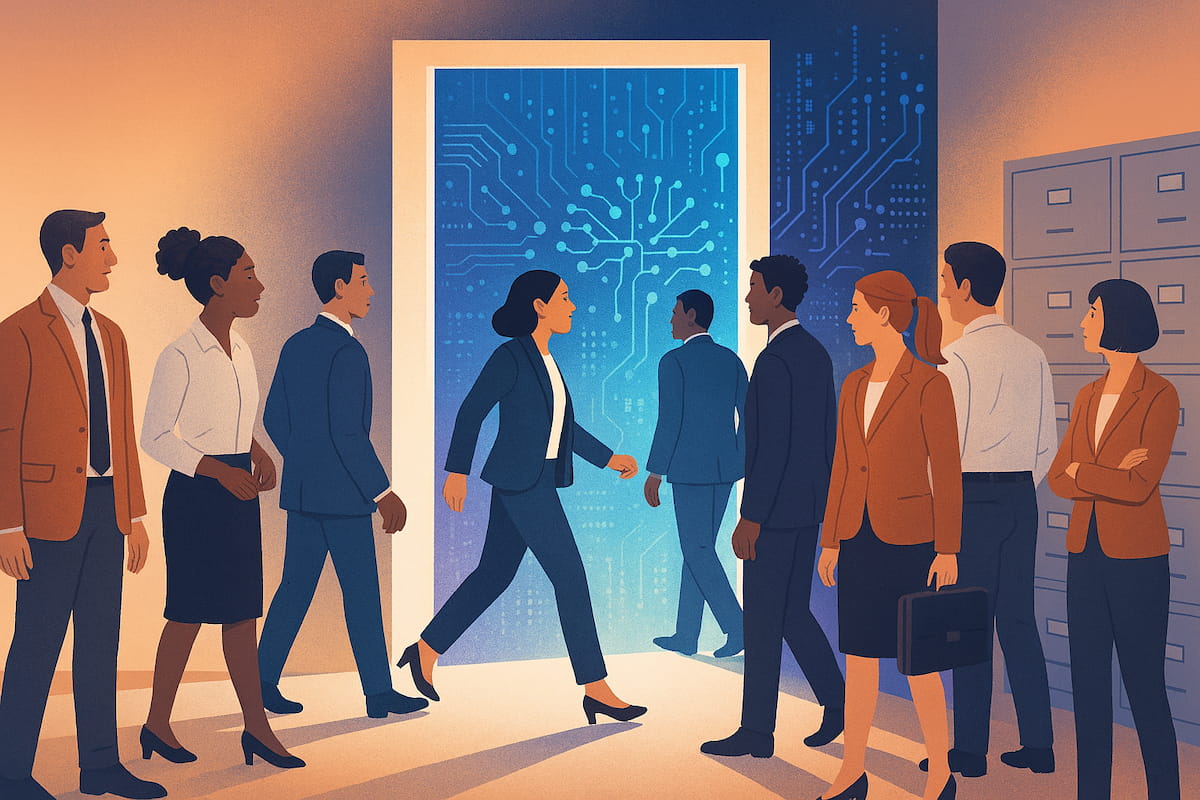
The AI Paradox in Knowledge Management: When Innovation Meets Fear
Organisations are excited about AI knowledge delivery. And terrified to actually use it. The paradox isn’t a technology problem; it’s a change management problem.
I had a fascinating conversation with a customer last week that perfectly captured the challenge many organisations face as they consider AI-powered knowledge delivery. They were genuinely excited as I demonstrated our AI conversational search capabilities. They watched as complex questions received instant, coherent answers. They saw how their teams could ask questions naturally instead of hunting through search and scrolling through lengthy documents. They could easily see the time savings, the reduced frustration, and the improved employee experience.
And then came the “but.”
“We can’t use AI for procedures or how-to instructions. They’re too complex. What if the AI misses steps? What if it skips a compliance requirement? What if a mandatory script is missed? What if someone follows the AI and it creates a regulatory issue or customer complaint?”
The pushback wasn’t skepticism about AI capabilities. This was the fear of losing control.
The Uncomfortable Truth We Need to Acknowledge
Here’s what I told them, and what I believe every knowledge management leader needs to hear:
Your current knowledge management methodology doesn’t guarantee compliance either.
Right now, your procedures exist as lengthy, complex documents that users must navigate, interpret, and apply to real human interactions. You have no visibility into whether they’re reading every step. You can’t confirm they’re following the exact sequence. You don’t know when they’ve skipped sections because they’re time-poor, or when they’ve misunderstood or simply missed something important buried in task seven of a twenty-task knowledge article.
The risk they’re afraid AI will introduce? Guess what … it already exists. The difference is that with AI, you’re suddenly very much aware of it.
Traditional knowledge delivery systems create an illusion of control. We review, approve and publish comprehensive, complex, non-linear procedures. We audit and maintain version control. We track who accessed what document, when.
But access doesn’t equal comprehension, and comprehension doesn’t equal correct application.
We’ve been managing compliance risk in environments where we have almost no insight into actual user behaviour at their point of need.
Why This Matters More Than Ever
The organisations I work with operate in highly regulated industries where compliance isn’t optional, and errors have real consequences. Financial services, healthcare, utilities, government agencies. These aren’t environments where you can move fast and risk breaking things. The caution and fear are warranted and appropriate for these industries.
But here’s the critical question:
Is the fear of AI actually about the technology, or is it about confronting how knowledge delivery has never actually worked as well as we hoped?
AI didn’t create the risk that users might miss critical steps. It reveals that risk has always existed. What AI does is force us to become explicit about things that were previously implicit and unexamined.
The Real Challenge: Change Management, Not Technology
Every customer conversation I have about AI eventually reaches the same realisation. The technology isn’t the hard part. We can tune retrieval accuracy, improve response quality, implement guardrails, and provide source attribution. Those are solvable technical challenges.
The hard part is changing how people work, how they think about knowledge, and how organisations measure and manage risk.
Moving from traditional knowledge delivery to AI-powered systems isn’t a technology migration. It’s an operational transformation that requires:
Redefining what “using knowledge” means. In a traditional system, using knowledge means searching for and opening a document. In an AI system, using knowledge means having a conversation. The shift from retrieval to interaction completely changes the user experience and requires a complete mental shift.
Rebuilding trust through transparency. Users need to understand not just what the AI told them, but why and where that information came from. This means designing AI systems that don’t just answer questions but show their work through source citations, roles and permissions and clear boundaries about what the AI knows and doesn’t know.
Rethinking governance and accountability. If we can’t verify that users read every step in a procedure today, what does compliance actually mean? Perhaps it means ensuring knowledge is accurate, accessible, and applied correctly at decision points, rather than assuming sequential document consumption. AI forces us to get real about what we’re actually trying to achieve.
Accepting that behaviour change takes time. People won’t immediately trust AI-generated answers, and they shouldn’t. Trust is earned through consistent positive experiences, not mandated through policy or technology.
A Phased Approach to Building Confidence
The organisations that successfully implement AI-powered knowledge delivery don’t do it all at once. They take deliberate, measured steps that allow both the technology and the people to grow together.
Start with low-risk, high-value use cases. Begin with informational queries where the stakes are lower and the user benefit is immediate. Questions about policies, definitions, general information, or “where can I find” queries are perfect starting points. Let users experience the value of conversational search in contexts where they can verify answers against existing knowledge without consequences for being wrong.
Maintain traditional access alongside AI. Don’t force an either-or choice. For critical procedures where risk is highest, keep the full procedural documentation accessible while allowing AI to help users navigate to the right section or understand the context. Think of AI as a knowledgeable colleague who can point you to the right place, provide quick answers, and not as a replacement for approved knowledge.
Create feedback loops that improve both systems. When AI provides answers, track what users do next. Do they ask follow-up questions? Do they access the source documents? Do they escalate to human support? This behaviour tells you where AI is working well and where it needs improvement. More importantly, it tells you where your traditional knowledge has gaps that neither system addresses well.
Build competence through pilot groups. Select champions from different teams who can test AI capabilities in controlled environments. Let them develop expertise, identify edge cases, and become change champions who can guide their peers through the transformation.
Your champions’ real-world experience becomes your most powerful change management tool.
Establish clear guardrails for different content types. Not all knowledge needs the same treatment. Informational content might be fully AI-accessible. Procedural content might use AI for navigation but require confirmation steps. Compliance-critical content might use AI for search but require formal acknowledgment of the authoritative source. Design your implementation to match your risk tolerance.
Measure what matters, not just what’s easy. Traditional systems measure page views and search queries. AI systems should measure successful task completion, time to resolution, reduction in escalations, and user confidence. This means you need to correlate your enquiry data with your AI data. If AI helps someone solve a problem in 90 seconds instead of 15 minutes, that’s valuable even if they also checked the source document for confirmation.
The Path Forward
The customer I met with isn’t wrong to be cautious. Their concerns about compliance and complexity are legitimate. Organisations in regulated industries have earned their caution through difficult and often costly experiences when getting things wrong.
But caution shouldn’t become paralysis.
I believe the answer is yes, but only if we’re honest about the limitations of traditional methodologies and committed to the change management required for successful AI adoption.
The question isn’t whether AI-powered knowledge delivery is perfect. The question is whether it’s better than what exists today, and whether it can become progressively safer and more effective over time.
AI won’t eliminate risk in knowledge delivery. What it can do is make risk visible, measurable, and manageable in ways that weren’t possible before. It can help organisations understand not just whether knowledge exists, but whether it’s actually being used effectively.
The organisations that will succeed with AI aren’t the ones that move fastest. They’re the ones that move thoughtfully, with a focus on both the opportunities and the challenges. They’re the ones that treat AI implementation as an operational change program, not a technology deployment.
They’re the ones who understand that the hardest part isn’t teaching AI to answer questions. It’s helping people learn to trust the answers.
What challenges are you facing as you consider AI for knowledge delivery in your organisation?
I’d welcome hearing your experiences and concerns in the comments.