When Requirements Aren’t Enough: Why Product Delivery Fails Without Shared Understanding
Last week, I was prepping for a customer demo when I opened the reporting dashboard and suddenly felt my stomach drop.
The primary data fields were empty. All of them. We’d built this beautiful reporting capability with clear requirements from the customer, what to track, how to display it, everything specified. And now, before showing it off, there was nothing to report on.
I panicked. Had we built it wrong? Missed a step? I pulled in the team, we traced through the implementation, and checked the specs against what we built. Everything was correct. We’d done exactly what was asked.
The problem? We’d never received any data to report on. Their integration wasn’t sending us what we needed.
Today, I met with the customer to discuss the reporting. They admitted something that made the whole situation make sense: they’d guessed at what they would need for reporting 12 months ago. They never brought their own IT department into the conversation. Their IT team didn’t even know there was a reporting requirement.
Later that afternoon, I was in a meeting with our Engineering manager. She said something that’s been repeating in my head ever since: “The team would love to hear about where we’re going and what they might be working on next. They want to know how their role fits into the bigger picture. They want to understand how their output directly impacts the end customer.”
And there it was. The same problem, from a different angle.
The Product Lifecycle Problem
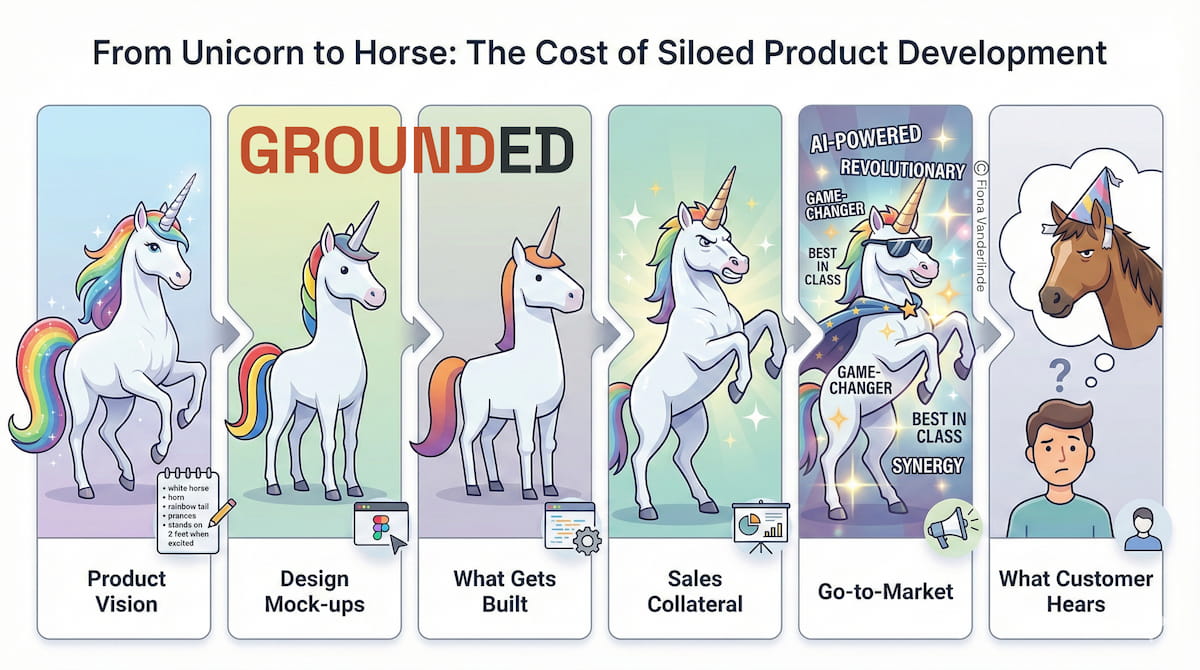
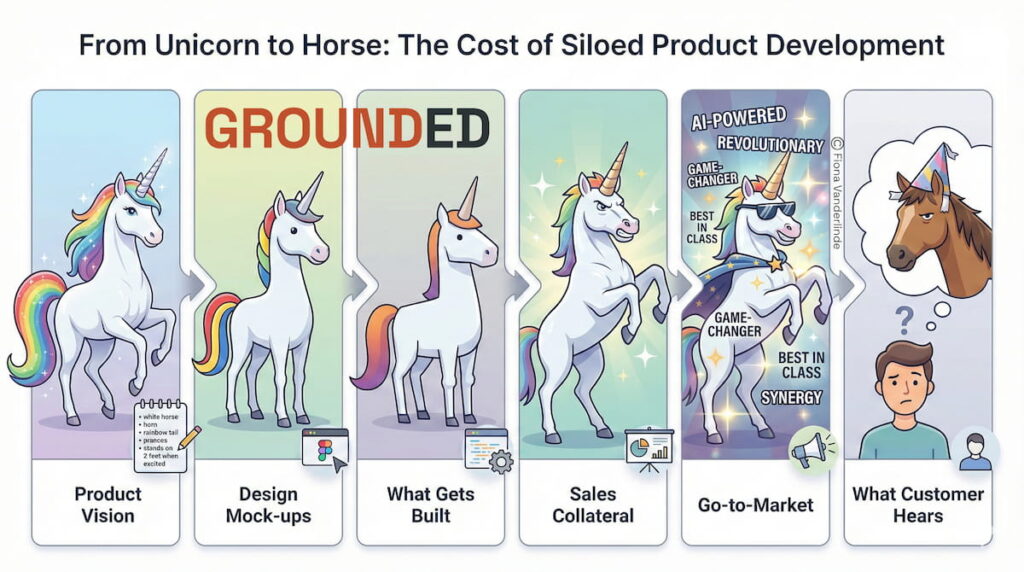
This is the pattern I see everywhere: Product defines a majestic unicorn. Design streamlines it. Engineering builds what’s technically feasible. Product Marketing positions it. Marketing amplifies it. Sales describes it to customers. The customer ends up with a horse wearing a party hat.
We blame “the product lifecycle” as if this is just how things work.
No. This is how siloed product development works.
And here’s what most people miss:
This isn’t a software problem. It’s an organisational problem that shows up anywhere complexity meets multiple teams.
The pattern is always the same: Requirements travel through departments. Each team interprets and optimises based on its constraints. Nobody’s malicious. Everyone delivered what was asked.
But the original intent didn’t survive the journey.
Why This Keeps Happening
Requirements tell you what to build. Intent tells you why it matters.
When teams only get the “what,” they optimise for their piece of the puzzle without understanding the bigger picture.
Our customer optimised their request without involving their IT team. Their IT team built integrations without knowing reporting mattered. Our engineering team built perfectly to spec without understanding the customer impact. I coordinated delivery without validating the data flow.
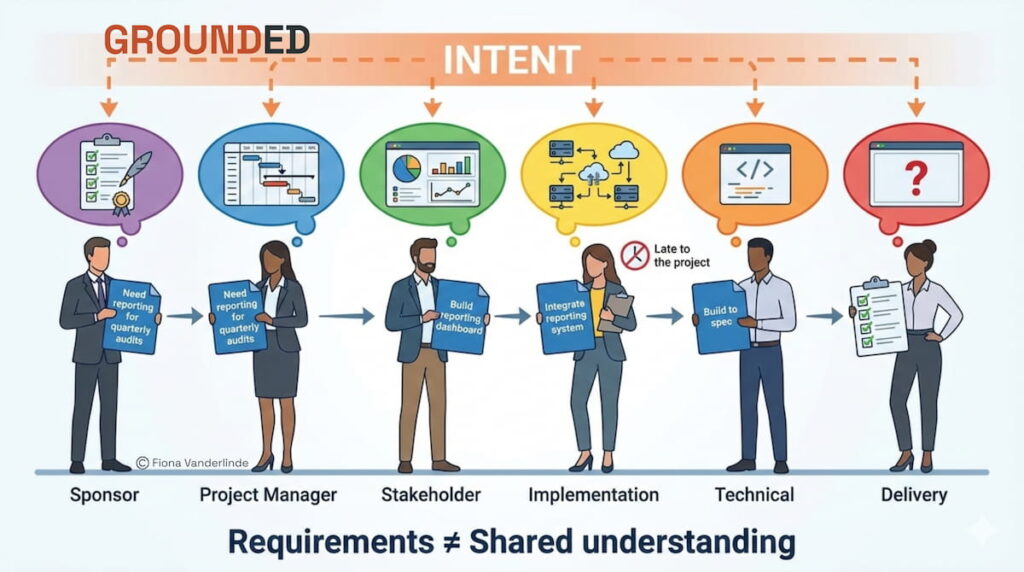
Every person in this chain did their job well. Every person in this chain was missing critical context.
This wasn’t a failure of competence. It was a failure of communication.
What People Actually Need
Here’s what I took out of this experience:
Good or bad, people want to be brought on a journey, not just given a task to complete in isolation.
Humans want to feel like their time is valuable and worthwhile. No one likes doing something only to learn it was a waste of their time.
Our engineers wanted to know why this reporting feature mattered to customers. The customer’s IT team needed to know there was a reporting requirement. I needed to understand the data flow dependencies before demo day.
We all needed the same thing: context.
Not more requirements. Not more documentation. Context.
- What problem are we solving?
- Who is this for and why do they need it?
- How does my piece connect to the whole?
- What happens if we get this wrong?
When people understand these things, they make better decisions. They ask better questions. They catch issues before demo day.
What Actually Works
Intent travels with requirements
“We need tracking capabilities” becomes “Our compliance team gets audited quarterly and needs to prove we’re providing accurate information to customer questions, that’s why we need the actual query text, not just metadata.”
Everyone understands the full picture
Engineers know the customer impact. Customers know the technical constraints. IT teams know the business requirements. Not as an afterthought, from the start.
Evolution is communicated, not just executed
When constraints force changes (and they always do), ask: “Does this still solve the original problem and do all the teams know about this change?”
Validation happens throughout
Don’t wait for the demo to discover the problem. Check understanding and whether the ‘why’ is still aligned. A completed task that misses the point is worse than not completing a task at all.
Bring the Human Element Back
This isn’t about more process. It’s about remembering we’re working with people, not just tickets and requirements.
When you treat people as part of a journey instead of isolated task-doers, you get better outcomes. You get teams that catch problems early because they understand what matters. You get customers who make realistic requests because they understand the constraints. You get engineers who build with the end goal in mind, not just the spec.
You get people who are driven and dedicated because they understand how their work matters.
Bring the human element back into software development and project delivery. Stop optimising for process efficiency and start optimising for shared understanding.
Because ticked boxes don’t solve problems. Shared understanding does.
And understanding requires treating people like people, not resources, not ticket-closers, not requirement-gatherers. People who want to know why their work matters and how it fits into something bigger.