AI Isn’t Taking Your Job. Someone Using AI Is.
“It’s AI so isn’t real”
That’s what my 14-year-old son said about the AI-generated image I showed him. Then he added, “Why do you like AI? Isn’t it taking everyone’s jobs?“
He said it like AI was inherently bad. A threat. Something to dislike.
So I told him about his great-great-grandfather. A gravedigger who used a pickaxe and shovel to dig graves by hand. Every single grave. By hand, night after night.
Today, graves are dug using machines. The task didn’t disappear; it changed. Someone still needs to operate the machine, ensure quality, and manage the process but there are not a lot of gravedigger positions anymore.
I told him about factory workers who used to do everything manually. Then the Industrial Revolution happened. Factory workers didn’t vanish. They evolved, learned to oversee machines, manage quality control, optimise production lines.
I told him about restaurants during COVID. The ones that pivoted to delivery and takeout survived. The ones that complained and insisted “real dining” meant sitting inside didn’t.
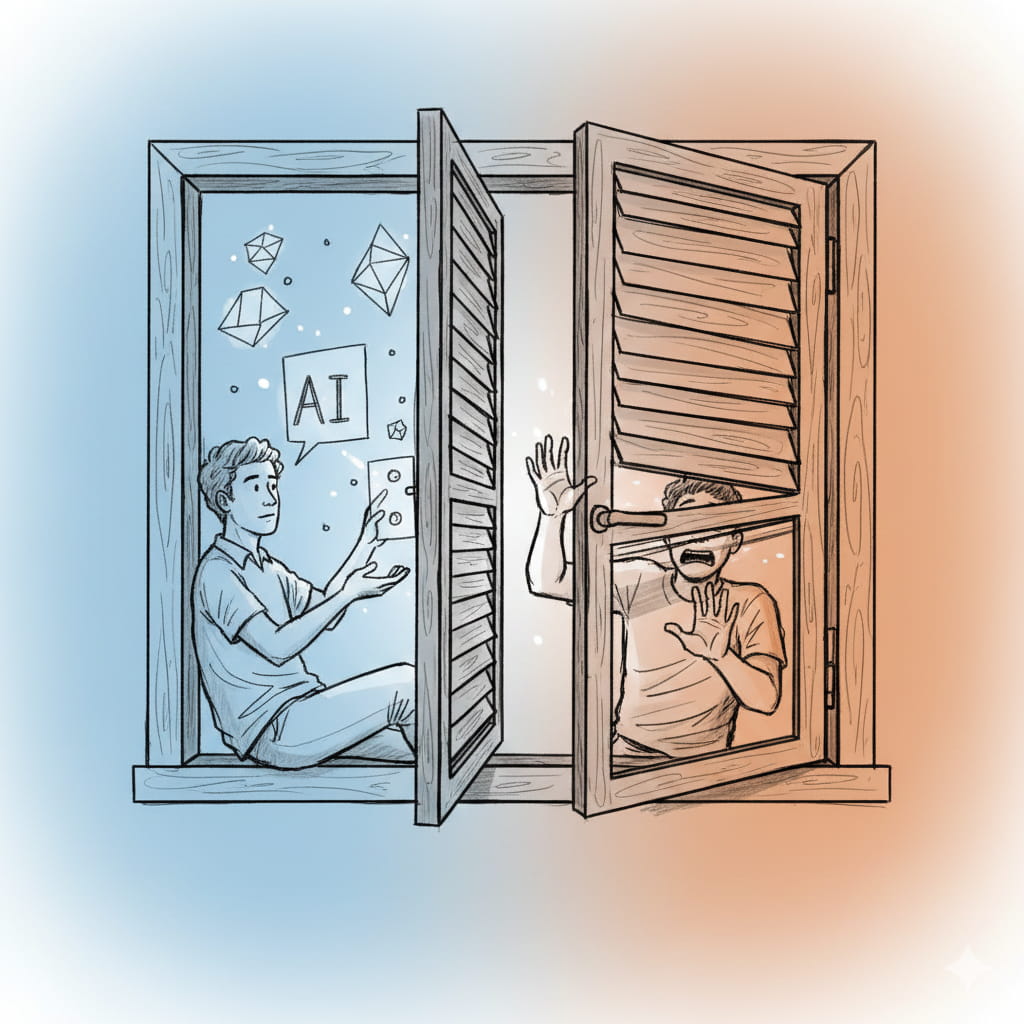
My point: AI is the same pattern. You either work with it and become the human in the loop, or you need to look for a new career.
His response? Nothing, he’s a typical teenage boy, remember.
The Pattern People in Denial Keep Missing
“It’s not real” is what people said about email. Not as good as a real letter.
Digital photos? Not as good as real film.
CD’s? not as good as records.
Online shopping? Not as good as real stores.
Remote work? Not as good as real offices.
The people who dismissed these things as “not real” watched their industries transform without them. They didn’t lose their jobs to technology. They lost them to other people who adopted and changed faster.
The COVID restaurant example nails this perfectly. Restaurants that pivoted to delivery didn’t do it because they believed it was “better”.
They did it because the world changed and they knew they had to change with it.
The ones that survived weren’t the ones with the best food. They were the ones who pivoted fastest.
Every technological shift works this way. There’s a window where experimentation is cheap and consequences are low. Then the window closes.
The gap between early adopters and sceptics compounds daily. With AI, that window is closing faster than most people realise.
What’s Actually Happening Right Now
AI isn’t coming. It’s already here. Quietly changing how work gets done across every industry, every role, every career stage.
My cousin is a nurse. She uses AI to help create reports and speed up manual admin tasks that take her away from direct patient care. AI doesn’t replace her clinical judgment or experience, it gives her more time to use it.
My partner uses it to draft emails, reports, presentations, and handle endless admin tasks that seem to take all day but show little output. They’re not working less; they’re delivering outcomes that actually matter.
Engineering teams are using it to write code faster, find bugs etc. They use it to automate deployment processes that were prone to human error. The code deploys faster with no errors or omissions. Engineers are not becoming obsolete, they’re becoming more effective.
My dad is using it to generate funny pictures and personalised visual messages for friends and social channels. He’s 75+. He’s not a “tech person.” He just saw something useful and learned it.
My colleagues have replaced Google search with ChatGPT search. Not because they’re early adopters, but because it gives them better answers faster.
Here’s what matters: None of these people are AI experts. They’re not data scientists or machine learning engineers. They’re just people who spent 30 minutes experimenting and found something useful.
The progression is telling. It starts with “silly pictures” and ends with “I can’t imagine doing this task without it anymore.”
This isn’t only happening in tech companies. It’s happening everywhere in normal daily life.
The Gap That’s Opening
Just last week, AI advancements were attributed to wiping $22.5 billion off Indian IT stocks. The country’s massive IT outsourcing industry could face severe disruption due to it’s heavy reliance on a labour-intensive delivery model.
But AI isn’t taking those jobs. Other humans using AI are.
Companies didn’t stop needing outsourced IT work. They just discovered they could do more with fewer people if those people knew how to work with AI tools.
The math changed. One person with AI could do what five people did manually.
Job postings now list AI skills. Not for AI specialists, for regular roles. Marketing managers. Operations analysts. Customer service leads. Project managers.
Conversations in meetings assume AI familiarity. “Can you run that through Claude?” “What does ChatGPT recommend?” If you don’t know what they’re talking about, you’re already behind.
This isn’t “learn AI or lose your job.” That’s too simplistic and too scary.
It’s this:
The learning curve is easier now than it will be later.
Right now, experimenting is low stakes. You can try things, make mistakes, figure out what works. In two years? Everyone else will already be proficient. You’ll be learning to crawl while everyone else is running.
The gap, it’s widening daily.
What to Do Tomorrow
You don’t need to become an AI expert. You don’t need to understand how large language models work or what tokens are or how training data gets processed.
You need to spend 30 minutes seeing what AI can do for your actual life.
Not work. Not “productivity.” Your actual, everyday life. The things you wish you could do but don’t have the skills, time, or patience for.
Here are some experiments to try. Pick one. Any one:
Creative Things You’ve Imagined But Can’t Make
The experiment: You have an idea for an image, a design, a visual joke, but you can’t draw. You’ve never been able to get it out of your head and onto paper.
Try this: Open Gemini (it’s free). Type exactly what you see in your mind. “A golden retriever wearing a business suit, sitting at a desk, looking very professional but slightly confused by a laptop.” Or whatever absurd, beautiful, or meaningful thing you’ve imagined.
See what happens. You might get something useless. You might get something amazing. Either way, you just created something that didn’t exist 60 seconds ago.
The “What Can I Make With This?” Problem
The experiment: You just bought a slow cooker. You have some lamb, random vegetables, and pantry staples. You want to make something edible but have no idea where to start.
Try this: Open ChatGPT. “I have a slow cooker, 500g lamb shoulder, carrots, potatoes, onions, garlic, canned tomatoes, and basic spices. What can I make? Give me 3 options with simple instructions.”
See what happens. You’ll get actual recipes. With cooking times and methods. Some will sound good. Some won’t. But you’ll have options you didn’t have 90 seconds ago.
Memory Gaps and Information Hunts
The experiment: You can’t remember that song lyric. Or the author of that book everyone referenced in the meeting. Or the name of that actor from that show you watched five years ago.
Try this: Ask Claude. “What’s that song that goes ‘something about summer rain’ from the 90s?” Or “Who wrote that book about habits with the story about the Olympic cycling team?”
See what happens. You’ll get the answer. Or three possible answers. Either way, you’re not stuck in a Google loop clicking through seven irrelevant links.
Home Repairs You’ve Been Avoiding
The experiment: That broken tile in your kitchen. You’ve been meaning to fix it for six months. You have no idea how.
Try this: Take a photo with your phone. Upload it to Claude. “This tile came loose in my kitchen. It’s ceramic, about 15cm square, attached to plasterboard. What do I need to buy and how do I reattach it properly?”
See what happens. You’ll get a list of materials and step-by-step instructions. You might still hire someone. But at least you’ll know if it’s a $20 DIY job or a $200 professional job.
Personal Messages You Can’t Quite Find the Words For
The experiment: It’s your partner’s birthday. You want to write something heartfelt and personal. But every time you start, it sounds generic or awkward or like a cheesy greeting card.
Try this: Open Claude. Tell it everything you actually feel in your own messy words. “She makes me laugh every day. She remembered my favorite coffee order after one conversation. She dealt with my family drama without judging. She’s the person I want to tell everything to. Write me a birthday message that captures this.”
See what happens. You’ll get something you can work with. Something that sounds like you but more polished. You can edit it. Make it yours. Or use it as a starting point to unlock whatever you were trying to say.
The Angry Email You Can’t Send
The experiment: Someone at work sent you a message that made your blood boil. You’ve written three responses. All of them will get you fired or a formal warning.
Try this: Open ChatGPT. Paste the original message. Then write exactly what you want to say, harsh words and all. Then: “Rephrase this to be polite and professional. I need to maintain a working relationship with this person, but address the issue clearly.”
See what happens. You’ll get your anger translated into something you can actually send. The core message stays. The career-ending tone disappears.
Research You Don’t Have Time For
The experiment: You heard about a new competitor. Or a company you’re interviewing with. Or a vendor pitching to your team. You need to know who they are, what they do, and whether they’re legitimate.
Try this: Open Perplexity. “Research [company name]. Give me their history, main products/services, key clients if available, and any notable strengths or weaknesses. Focus on the last 2 years.”
See what happens. You’ll get a summary with sources. It’s not perfect. But it’s a hell of a lot better than trying to piece together information from their marketing website and three random LinkedIn posts.
Learning Something New Without Taking a Course
The experiment: You want to understand how mortgage interest actually works. Or what “API” means when your technical team keeps saying it. Or how to read a financial statement.
Try this: Ask Claude like you’re asking a patient friend. “Explain how mortgage interest works. I understand basic math but not finance. Use an example with real numbers.”
See what happens. You’ll get an explanation at your level. No jargon unless necessary. No assumptions about what you already know. No judgment about what you’re asking.
Planning Something Complex
The experiment: You’re planning a trip to Japan. Or a 40th birthday party. Or a home renovation. You have ideas but no structure. Every time you start planning, you get overwhelmed.
Try this: Open ChatGPT. “I’m planning a 10-day trip to Japan in autumn. Two adults, moderate budget, interested in food and temples, not interested in shopping or nightlife. Give me a rough itinerary framework I can customise.”
See what happens. You’ll get a starting point. Something to react to. You can say “no, that’s too rushed” or “yes, but add more time in Kyoto.” You’re editing instead of creating from scratch.
Pick one. Any one. Try it tomorrow.
You’re not committing to using AI for everything. You’re not replacing your brain. You’re just seeing if this thing everyone’s talking about is actually useful for something in your life.
Maybe it’s useless for what you tried. Fine. Try a different experiment.
But if you find one thing, just one thing, where AI saves you time, solves a problem, or lets you create something you couldn’t before?
You’ve just answered your own question about whether it is “real.”
The Reality Check
Some jobs will disappear. That’s the honest truth. Not because AI will do them perfectly, but because AI will do them “good enough” and faster and more consistently than a person ever could.
Some jobs will change dramatically. Software developers, writers, analysts, designers, they’re not going away. But the ones who use AI will be exponentially more productive and sought after than the ones who don’t.
Most jobs will just have different tools. Like my cousin, partner, and engineering teams. Their work is still required, the methodology and tool set will change.
Here’s what determines which category you’re in:
- Whether you’re learning the tools now or later.
- Later = catching up while everyone else is already proficient.
- Later = competing against people who’ve had years of practice.
- Later = trying to learn under pressure instead of casual experimentation.
My son thinks “it’s not real” is a criticism of AI. He’s wrong.
“It’s not real” is a description of people who refuse to experiment. They dismiss the tool instead of testing it. They wait for permission instead of trying it. They insist the old way is better without ever comparing or trying the new. It reminds me of when he was much younger and refused to try new foods as they were all ‘yuck’.
My great-grandfather never got the chance to try new methods. After he stopped digging graves by hand, they moved to explosives and alternatives before machines even arrived. His work was so hard that when he stopped, no one wanted to take it up so they found different ways to do it. His old job didn’t just change, it disappeared entirely.
That’s what happens when you wait too long. The work doesn’t adapt to you. It moves on without you.
That’s the move. Every time.
Not “resist change.”
Not “wait until everyone else figures it out.”
Learn the new tool while you still have the chance. See what it does. Decide if it’s useful.
The window for casual experimentation is open right now. In under two years, it won’t be. You’ll be competing against people who’ve been using these tools daily for years.
Your choice isn’t “AI or no AI.”
It’s “adapt while it’s still optional or scramble when it’s mandatory.”
I know which one I’d choose.
Ready to Experiment?
Try one prompt tomorrow. Just one. On your actual work, or in your daily life.
See what happens.
Then decide if my son’s right, or if “it’s not real” is just another way of saying “I’m not ready to try.”